I've written the following in response to a request for help in understanding the basics of 12v electricity.
Basic 12v electrical elements
I make no apologies for the drawings - I can't draw worth a bean. In fact, since the drawings have a certain "Captain Underpants" sort of tone, perhaps the story should have somewhat the same tone.
let's begin with a basic premise.
"It takes energy to move anything."
The journey begins with a basic understanding of Potential (energy) Difference.
Let's suppose that you have your inoperable vanagon at the bottom of an upwardly sloped driveway and you have to push it uphill to your garage at the top.
As you struggle and call your van all sorts of kind and endearing names you are investing energy in the van - it takes energy to move it up that driveway.
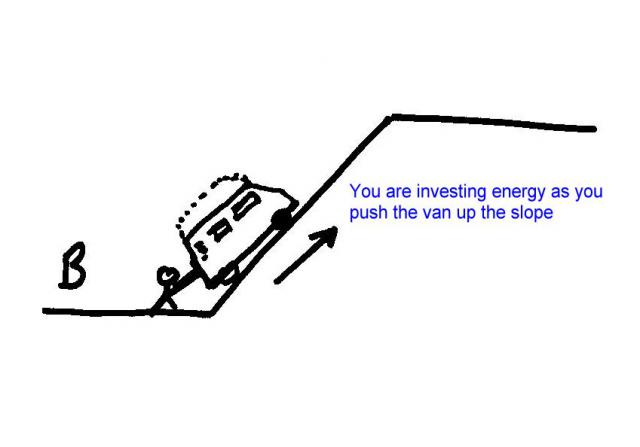
After a while and lots of colourful language, you have it at the top
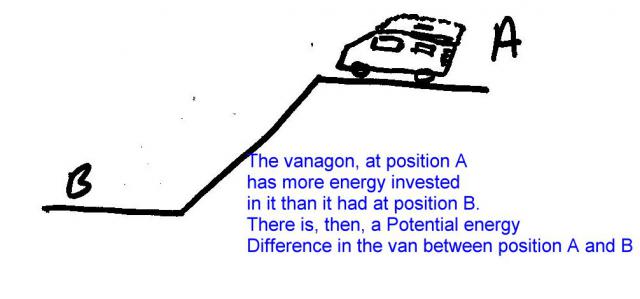
The van is sitting at position A and, due to the fact that you invested energy to get it there, there is a Potential (energy) Difference in the van at Position A relative to Position B. You created the Potential (energy) Difference by investing your energy in moving it from B to A.
So - what does this have to do with 12v circuitry or any electrical circuitry for that matter? Well - everything and nothing at the same time. But - the concept of Potential (energy) Difference is critical.
Relays – what are they, how do they work, why use them ?
Good questions …. But …. Before I tell you that story, I have to tell you this story. The story of the Eclectic Electromagnetic Eel – OK – so its not eclectic or have anything to do with an eel – but the alliteration was great and the electromagnetic part is what its all about …
If we take a normal piece of ferrous (iron) metal and wrap loops of wire around it
What is the role of a battery? - Well, in true Captain Underpants fashion, before I can tell youthat story, I have to tell you this one.
Let's look at the Bohr diagram for an atom of Helium - you'll see why in a moment.
Since all matter is made up of atoms, the relationship of the electrons and protons is relevant to the journey. The relative discrepancy in the size of protons and electrons is immense (I'm sure that someone will chime in here with the exact ratio) but suffice it to say that relative to electrons, protons are very very heavy and electrons are very, very, very, very light relative to protons. Anyway - the relative masses of the two charged bodies is so disparate that if an equal amount of force is applied to each of them, it will be the electron that will move - every time! Electrons move, protons do not.
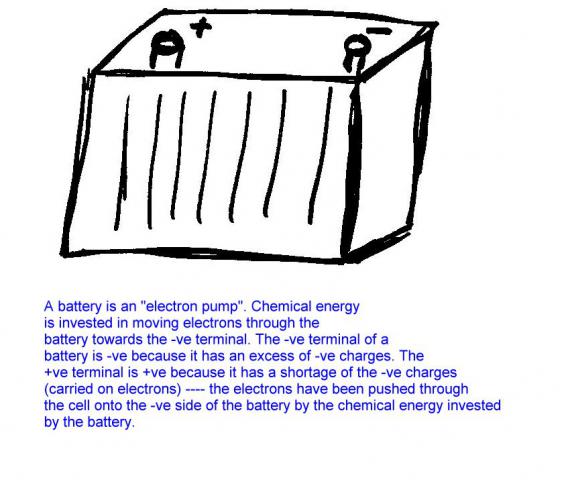
Now - back to the battery - a battery is an electron pump. It invests chemical energy in moving electrons through a battery until there is a collection of them at one side, because it is a collection of negative charges, we call it the negative terminal.
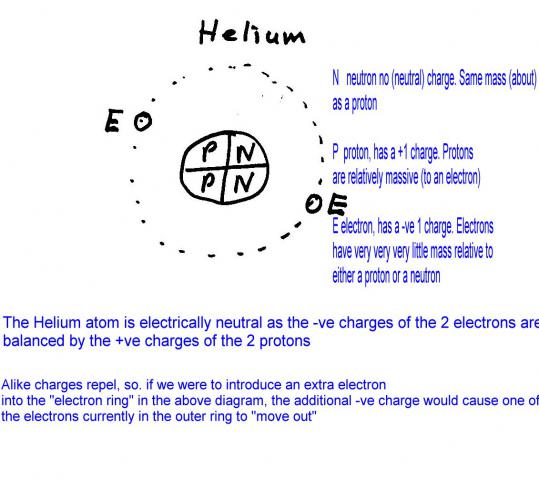
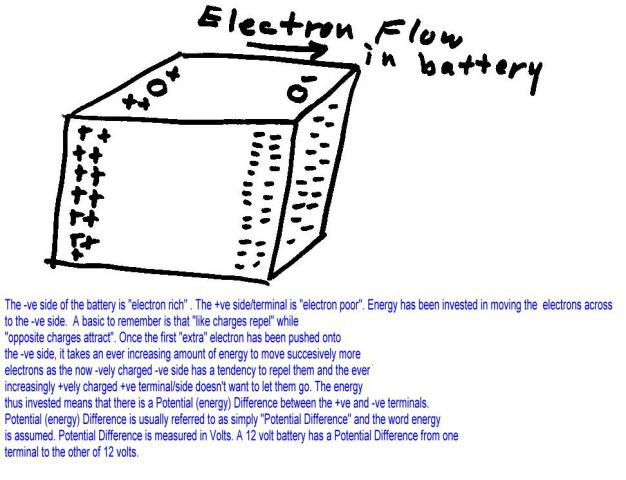
The –ve terminal of the battery is “electron rich” i.e. it has an over abundance of electrons. Conversely, the +ve terminal has a shortage of electrons, therefore the +ve protons have very few –ve charges to balance them, leaving the +ve terminal “electron poor” and therefore +ve.
A basic to remember is that “like charges repel” and “opposite charges attract”. Once the first extra electron has been pushed onto the –ve terminal, it becomes increasingly difficult to push successive –ve charges onto it. Also, the +ve terminal will be trying to attract them back. This means that the battery has to invest chemical energy to overcome these forces to push electrons onto the –ve terminal. The chemical energy invested means that there is a Potential (energy)Difference between the +ve and –ve terminals. Potential energy Difference is usually referred to as simply Potential Difference and the word energy is assumed.
Potential (energy) Difference is measured in Volts.
A 12volt battery has a Potential (energy) Difference of 12 volts
Just as the van at the top of the driveway was at a higher Potential (energy) Difference by virtue of the energy invested in it, so too, are the collective pool of electrons at the negative terminal at an elevated Potential (energy) difference.
OK - its new years eve - I'm being asked WTF am I doing - I'll edit this later and add the rest of the story - i.e. the exciting story of volts, amps, ohms, watts and the unbelievably exciting factors that govern resistance/conductivity and maybe even a basic circuit or two ...
Happy New Years!!
OK - I'm back - can't watch that chick flick they've got on - I mean, I am a SNAG (sensitive New Age Guy) but there are limits ....
So - we know about Potential (energy) Difference - i.e. Potential Difference. And, we know that if we introduce an electron into the electron ring of an atom that its likely going to cause an electron currently in that ring to move out if there is a way for it to "move out".
Let's look at a material that is a good conductor of electrons, Copper.
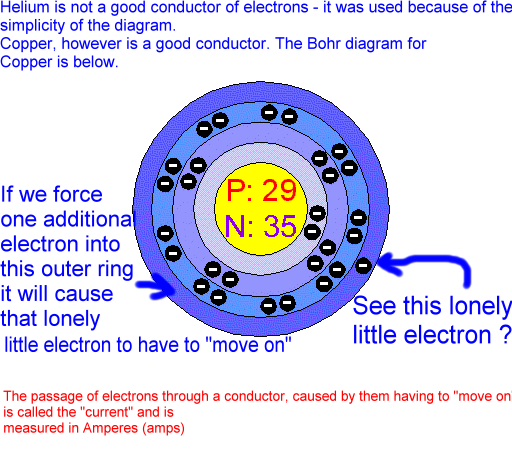
Probably the vast majority of the wiring in our vans is copper wire. When connected to the battery, it provides a medium that would allow electrons to flow from the -ve terminal, if there was a place for them to flow to.
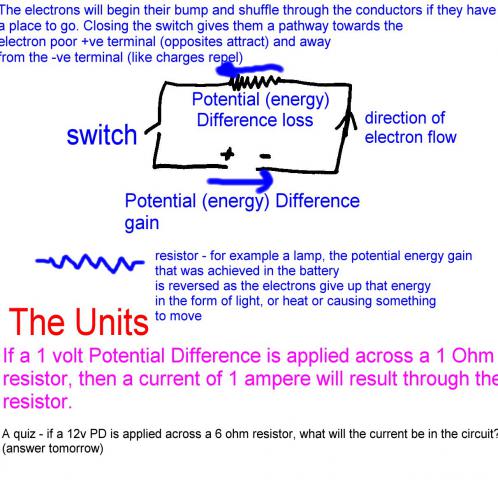
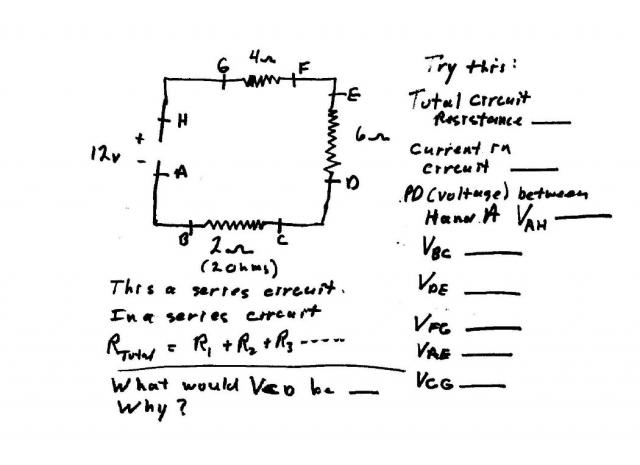
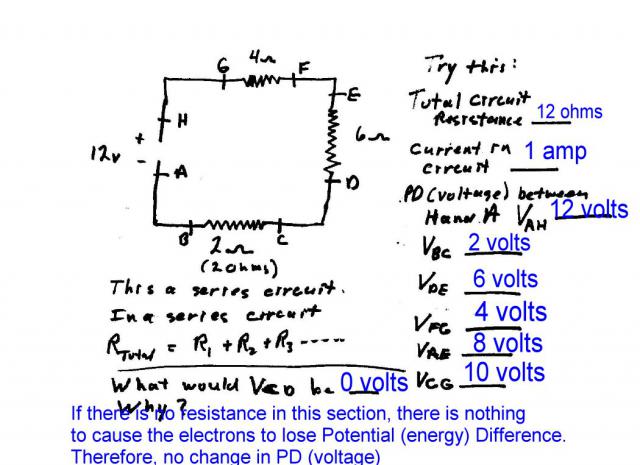
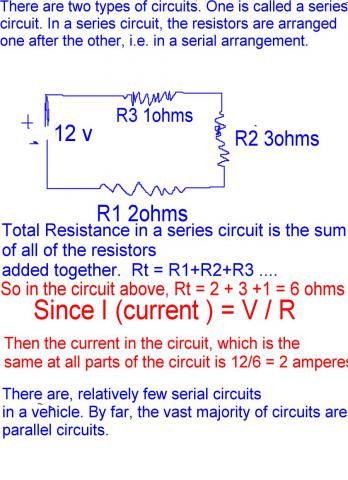
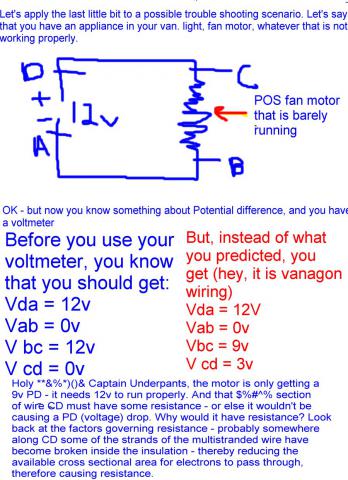
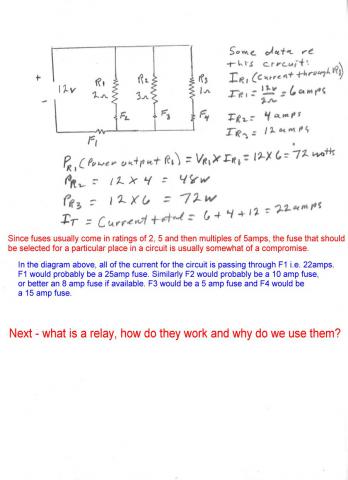
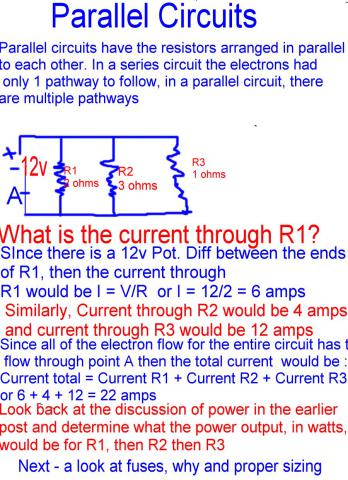
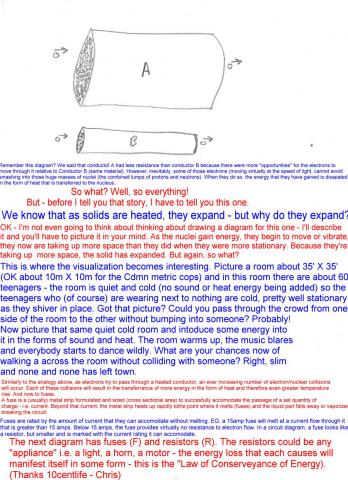
The next section contains some questions and answers as they happened on Samba as well as as a back and forth re energy and power between myself and 10centlife - probably of interest to at least one other person other than Chris or myself (maybe)
Q. One question that has me going is the door switch to the dome light. As I understand it, it switches the ground not the +12v. How many other circuits are like this and more to the point why? It doesn't seem to make any sense to me to have a hot wire hanging out just looking for a chance to contact something and short out.
A. OK - maybe a diagram with my incredible art work later - the negative terminal of the battery is attached to where? To the chassis !! This means that the electron flow is from battery to chassis through the "ground connection" to the appliance and then (after having given up its energy by doing whatever work the appliamce was meant to do) back to the +ve terminal. So does it really matter what side of the appliance is switched?
If the switch is between ground (chassis and therefore electron supply) and the appliance and is open, no electron flow. If the switch is on the other side of the appliance, still no path for the electrons to get back to +ve terminal so no flow. The connections to the +ve terminal are only "hot" because they provide a pathway for the electron flow back to the battery.
Understanding that the electron highway is a 1 way highway and starts at the -ve terminal, connects to the huge intersection of the chassis with many connections to work stations, each of which if connected via a pathway back to the +ve terminal would allow the electrons to pass through and do some work before continuing along the 1 way pathway back to the battery to regain the Potential (energy) Difference that enabled them to move in the first place.
We often hear "clean your grounds" on this forum. Without a good connection from chassis to conductor, there is likely to be resistance at that connection, therefore a voltage drop which means that the appliance downstream is not going to get the energy it needs to work effectively.
Q, this relates to the season we are in right now. Why is the electrical system affected by colder temps, especially below freezing?
A.Re the cold and vehicle electricals. Answering this question is somewhat dependant on the assumption that its the starting function of the van that you're talking about.
The battery produces the Potential (energy) Difference between its terminals by a chemical reaction. The rate of the chemical reaction in the battery, as most chemical reactiions, varies with the temperature. So, if the temperature drops, the chemical reaction in the battery slows down and the battery loses some of its ability to function as an electron pump.
There are other factors as well - any lubrication in moving parts seems to be thicker, harder to move through. We use thinner oil in the winter to alleviate some of the strain on the battery at this time as it tries to provide the energy to turn the starter that in turn is trying to turn the engine over.
Up here, in Canada, my rule of thumb has always been (when replacing a battery) never mind the OEM rating on the dead battery - measure the space and get the biggest thumping battery with the highest number of cold cranking amps that will fit into the space. Far as I'm concerned, the extra capacity is only helpful when its really cold.
Now – depending on how much of the “why” of it al you want to know, we’re sorta at a crossroads. You can take what we’ve done to this point and probably use it to figure out most of what is happening with your 12v electrical.
BUT - if you’re interested in the “why” of it all, we have to go a little deeper.
Potential Difference aka Potential (energy) Difference – the concept that we currently have is fine and will do. Suffice it to say, that the Potential (energy) Difference is the “motivational force” that will cause electrons to move throughout a conductor if there is a place for them to move to.
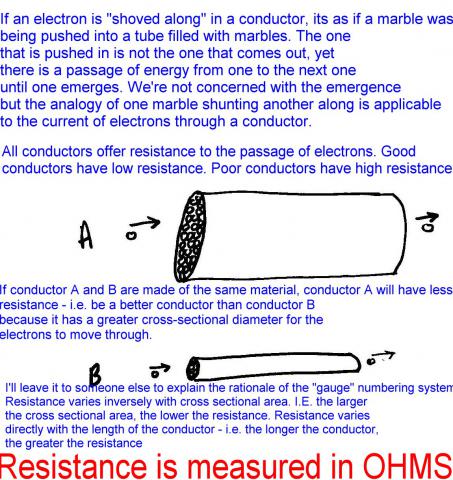
Resistance – measured in ohms and is a characteristic of all matter. Good conductors have low resistance. Resistance in a conductor will cause energized electrons to have to use some or all of their energy to move through the resistor. The energy that is used will manifest itself in some form of energy, sound, light, heat, motion (eg). The Law of Conservation of Energy is that Energy is neither created nor destroyed – it can merely be transformed from one type to another.
Current - measured in Amperes – this is the area in which we have to delve deeper if we wish to have a more complete understanding.
We said that current was the ‘passage of electrons”. Well, it is, but we need a more complete understanding. Our basic concept was that the electrons gained energy (Potential Difference) by having energy (chemical energy in the case of a battery) invested in them in moving them onto the –ve terminal of a battery. OK – so then we had electrons moving through a circuit and we called the passage of electrons “the current” and said that it was measured in terms of units called amperes.
BUT – current implies a rate of flow – and a rate of flow implies a quantity of electrons (charge). SO now we need some unit to describe a quantity of charge. The unit that is used to describe a unit of charge is the “Coulomb”. The exact number of charged electrons in 1 coulomb is huge – remember that electrons are really really tiny and each carries only a tiny bit of charge, but that there are an immense number of them. However, if you can imagine a collection of electrons in whatever shape or form you want to visualize it in (a “pail” of electrons or a “cloud” of electrons – it doesn’t matter but it is a huge collection of electrons) – then you can imagine that quantity of electrons (charges) moving past a point in a conductor in a period of time. OK – sort that visualization out in your mind, then go on –
If we have a “coulomb’ of charge passing through a conductor in a given period of time, we have a rate (of passage) of charge. And so - if we have a rate of passage of charge of 1coulomb of charge in 1 second, we have a current of 1 ampere. So:
Current(in amperes) = Charge(in coulombs) / time(in seconds)
But – we don’t really care about charge per second – we’re really interested in the work, or energy that we can get that energized collection of electrons (charges) to do for us.
Our basic unit for energy is the “joule”. If we can extract 1 joule of energy from 1 coulomb of circulated charge, then there must have been a “motivational force” or Potential(energy) Difference of 1volt causing that collection of charge to move.
Let’s use this a bit to get the concept clearer.
If we had a Potential Difference of 12v, how much energy could we extract from each coulomb of circulated charge?? Think it through until you can rationalize the answer of 12 joules then go on.
OK – so now we have a concept of energy as it relates to volts and amount of charge. But – we don’t use units of charge much – we generally work in terms of the effect of the charge (energy extracted) and the rate of passage of the charge (amperes)
We know that 1 ampere is the passage of 1 coulomb of charge n 1 second
Remember that Amperes is I (capital i) so I(amperes) = charge (coulombs) / time(seconds)
But if 1 volt of PD results in 1 joule of energy per coulomb of circulated charge
PD(volts) = energy(joules) / charge (coulombs)
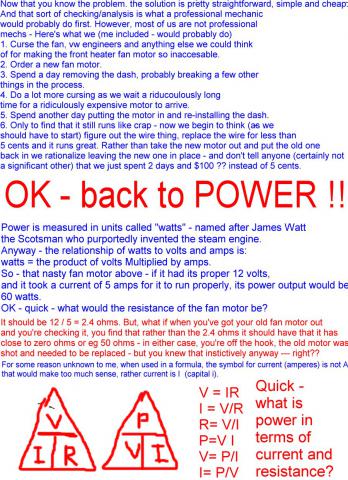
Now, if Power = Volts X Amps then Power(watts) = PD(volts) X Amps
But if volts = Joules/coulomb and if amps = coulombs/second
Then power P = Joules/coulomb X coulomb/ second or after we do the math
Power(watts) = Energy(joules)/time(seconds)
So – what does this have to do with anything? I got started on this this morning after checking the Bentley bible to see how it compared to the “theory” that we have been discussing. I came across this on page 97-3
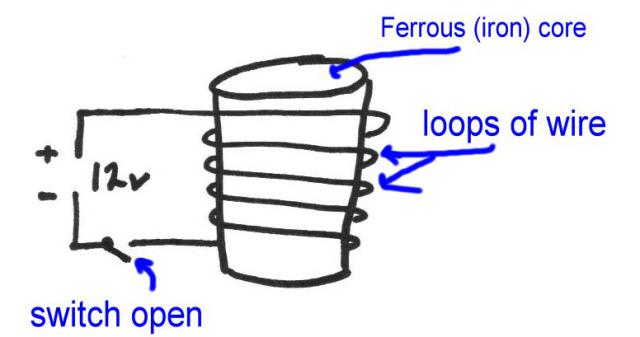
And then pass a current through the loops
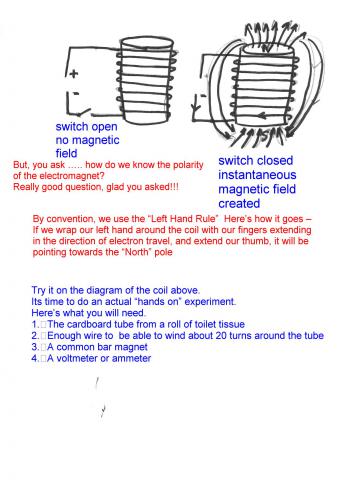
We create an electromagnet. (I’ll leave it to someone else to explain the polarity of the magnet – I’ve forgotten it) Suffice it to say that an electromagnet can be very very strong, depending on the ferrous core, the number of loops and the current passed through them. It also has the advantage of creating its magnetic field virtually instantaneously when a switch allowing current to flow is closed. The magnetic field also ends virtually instantaneously once the switch is opened
OK – the ability to create or destroy a magnetic field virtually instantaneously is really attractive (crummy play on words intended) because magnetic fields can make things move.
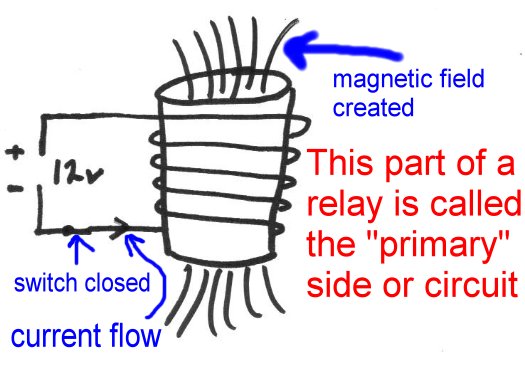
In the diagram above, with the switch open, no current is flowing, therefore no magnetic field, therefore no complete secondary circuit – the return spring is holding the contact points of the secondary circuit apart (open).
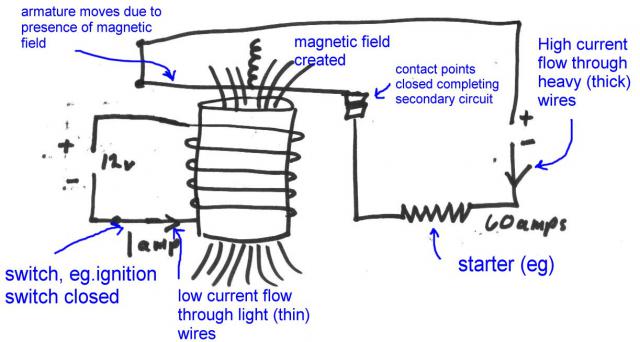
But – as soon as we close the switch …
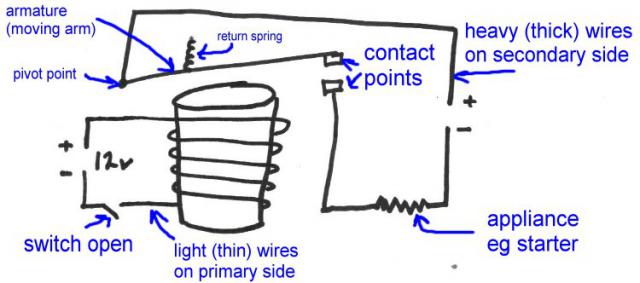
We use relays to control high currents remotely with very small currents. The wires from your battery to your starter are really thick – they have to be to carry the high amount of current that the starter requires. You wouldn’t want wires that thick with that much current running through them up around your ignition switch – so, we run light wires up to the ignition switch (for example) and control the secondary circuit that supplies the starter (for example)with the high current that it needs.
Relays are sometimes called solenoids, or servos and a lot of other names when they don’t work. But they are used extensively to control heavy current flows.
Sometimes the same electromagnetic principal is used to control other systems. For example, in a diesel engine, the Fuel Shut Off Solenoid, when activated, pulls a metal plunger out af a fuel passageway allowing fuel to pass through the injection pump. If the current to the FSOS is cut off, the spring loaded plunger snaps back, blocking the passageway and the engine shuts off. Household appliances (although not 12v) still use solenoids and relays extensively. The small contacts on the rotating timers of dishwashers, washing machines and dryers are all switches in the primary circuits of relays and solenoids that contol the various functions of the machine.
.
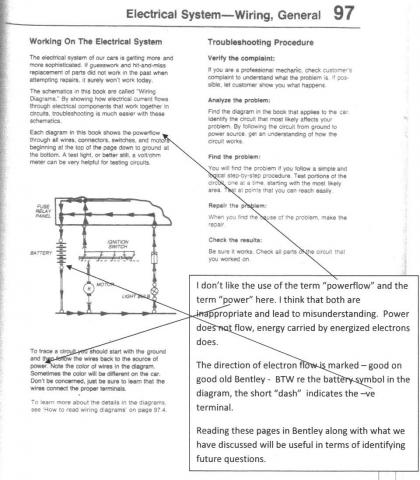
10centlife wrote : I agree that the Bentley description may not be as clear as it could be, and terminology can already get confusing, but I would differ with your saying "power does not flow, energy carried by energised electrons does". The reason why I differ is because that is going to bring people up against the common definitional convention, which is that power = volts x amps (or P=E x I), while energy = power / time.
Take a look at your home electric meter. The speed of the disc spinning you can directly observe represents the power your house is using, the unit of measurement being kilowatts (1000watts). But you get billed for that observable rate over the duration of time that it is being used, the billing unit being kilowatt-hours (1000watts for 1 hour).
Kilowatts is power, the rate at which work is getting done*.
Kilowatt-hours is energy, or the work that got done.
*(actually in a time unit of one second, so it is still a power/time function, but we tend to disregard the second in coulomb-seconds)
Seems like you would want to avoid swapping the terms because later on when people try to apply them they will find contradictions.
You're right, or at least I agree, that power does not flow. Current could be said to be flowing, perhaps, or at least it's easiest to think of it that way.
Another note on terminology: it's easy to be confused when you see E being used for V, I for A, and I would say less so when R substitutes for R. The difference is that the former letters are used schematically, as in representing the concept or principles involved, while the latter represent actual measurements.
The actual derivations are French, but for us we can think of E as Electromotive force, the force pushing electrons thru a circuit. I is Intensity, referring to the rate of electron flow, and of course R was in both cases Resistance.
P is power, the unit being W, a watt. P ended up like R, Puissance meaning the same thing as Power and beginning with the same letter, so another place we got lucky.
But when you see V, A, R and W, they're supposed to be meant to indicate measurable values, although people are pretty careless about that.
E = I x R (V = A x R)
P = E x I (W= V x A)
But then you get the use of E as energy, as well as Electromotive force. I'm not quite sure what the convention is on differentiating those.
Oh, and just for mind-blowing grins, a coulomb is 6.24151×10 to the 18th power.
That is 6,241,510,000,000,000,000 electrons.
What I want to know is who sat there and counted them?
JC replied: Good comment Chris - gotta say though that even as kwh are a measure of energy, North America kind of stands alone in terms of expressing energy as anything other than what it is. There was a movement about 25 years ago to move Canada to the world standard and actualkly measure energy in joules and bill according to megajoules used. The movement "blew fuses" in the U.S. because of the momentum of the existing practice of using kwh - the whole exercise was deemed just "too damn furrin" by U.S. nabobs who contiunue to think that the populace can't think in world terminology - geez - even the metric system scares those guys. Because of the international nature of the energy grid that works between Canada and the U.S. the initiative was shut down. The U.S. populace is more than capable of thinking and working with world standards - sooner or later the populace of the U.S. will tire of paying a premium to work in non-metric units and the change will occur.
OK - just a little rant on my part. But - wouldn't be nice to think of energy conservation in terms of the actual energy conserved? Eg. if you were to turn of a 100w light bulb for 1 minute, you would be not using (saving) 100 j/s X 60s = 6000joules of energy. How many Kwh is the same action saving? Well - since 100w is .1 of a kw, we're saving .1kw per second - but since we need it in hours not seconds, we have to divide .1 by the product of 60 m X 60s/minute = 3600 So now we're doing the division - not too many of us can do this one in our head, certainly not me - and we get that we're saving 2.777 X 10 (to the exponent -5) or .0000277 of a KWH.
Back to 10cent's comments above. I really value them because they provide another perspective. When one begins a journey such as explaining basic electricity, one has to give a fair bit of thought as to how to do the opening descriptions. Personally, I really like the entire concept of Electromotive force. However, the visualizations of creating Potential(energy) Difference and therefore the concept of Potential Difference (volts) was just too attractive to pass up. Who of us hasn't, at one time or another, pushed their van up a hill?
I probably should have made the transferrence to Electromotive force when I jumped to the role of the battery - but then I would have had to, sooner or later, defined "force" Nevertheless, I really like the terminology ElectroMotive Force. Personally I think that it should always be written in a formula as Emf not E, just to avoid the confusion you allude to above. I think that a lot of the time manuals and books written on technical matters are written by folks with such a deep understanding of their subject matter that they have real difficulty perceiving the topic or concept from the perspective of their readers. I mean what would it really take to use Emf instead of E for electomotive force and leave E for energy? Certainly, when I taught Physics before I went into school administration, I was very careful to always use descriptive subscripts and abreviations to attempt to de-mystify physics.
Back to my rant above re joules vs kwh - about 4 years ago when I put an evacuated tube solar Domestic Hot Water system on my roof, all of the options re sizing were rated in terms of the joules of energy captured.
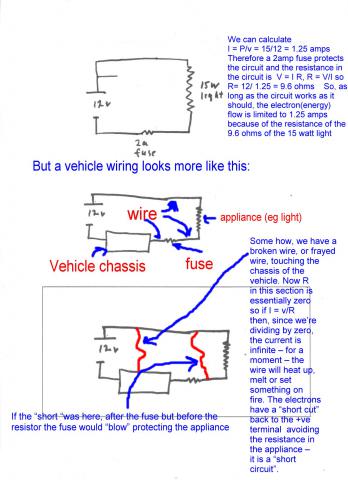
Short circuits are usually pretty easy to diagnose - usually there's a burnt wire, melted insulation or, if we're lucky, a blown fuse. The following diagram attempts to explain why either occur
Coils – we’re a bit beyond the “basics” here, but you might be interested in this.
Remember our diagram of the electromagnet as we used it in the context of a relay?
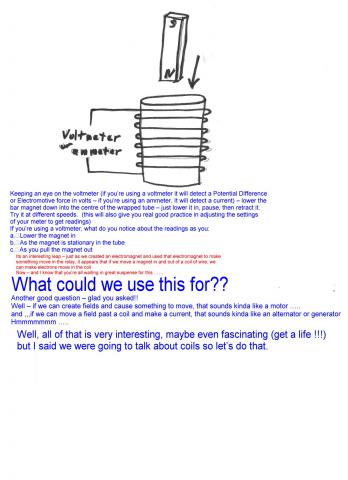
Its an interesting leap – just as we created an electromagnet and used that electromagnet to make something move in the relay, it appears that if we move a magnet in and out of a coil of wire, we can make electrons move in the coil
This next piece of incredible art work is supposed to represent a tube wrapped with wire turns inside another tube wrapped with wire turns (sometimes called “windings”).I tried to draw a “cutaway” view of the tubes
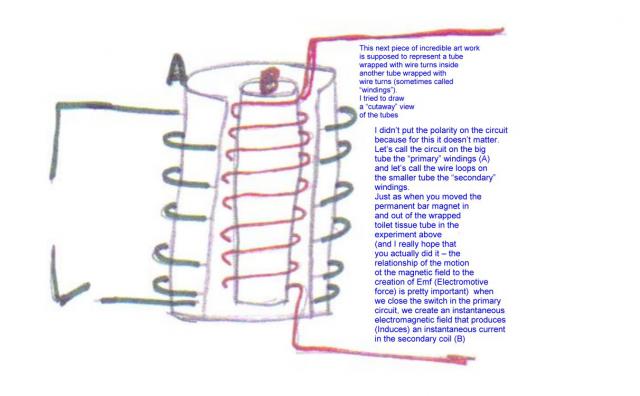
I didn’t put the polarity on the circuit because for this it doesn’t matter. Let’s call the circuit on the big tube the “primary” windings (A) and let’s call the wire loops on the smaller tube the “secondary” windings.
Just as when you moved the permanent bar magnet in and out of the wrapped toilet tissue tube in the experiment above (and I really hope that you actually did it – the relationship of the creation of the magnetic field in the primary circuit relative to the creation of Emf (Electromotive force) in the secondary circuit is pretty important) when we close the switch in the primary circuit, we create an instantaneous electromagnetic field that produces (Induces) an instantaneous current in the secondary coil (B).
I can feel the excitement …….
OK – so now, how can we use it?
Remember the Law of Conservation of Energy ?
Well, we also remember that Power(watts) = PD or Emf(volts) X Current(amps)
If we had, in the primary circuit, V = 12volts, Current = 2 amps, then P would be 24watts … right? RIGHT!! Remember that.
If we had a different number of windings on the secondary coil relative to the primary, say we had 10 windings on the primary and 50 on the secondary – then there would have been 5 times as many wires in the secondary in which to induce an Emf in than in the primary … so
So: windings primary 10 windings secondary 50.
Voltage primary 12v current primary 2 amps power primary 24 watts
However in the secondary
Voltage = 12 X 5 = 60volts, but because of the law of conservation of energy, current -= 2 / 5 = .4amps and the power = 60 X .4 = 24 watts.
So what??
Well – did you ever wonder how you could get (say) the 12000 volts necessary for an ignition system to work from a 12 volt battery?
There’s more to this incredibly exciting story …. But …. Later.